
Aid debate: "We need less governance arrogance in Norwegian aid"

Assistance for falls?
A complete overhaul of aid from the United States, and major European aid cuts, have had, and will continue to have, disastrous consequences for millions of people in poor countries.
This is the backdrop for Caritas' annual aid debate at Arendal Week. The global aid order as we know it is in ruins. This must also have consequences for the way Norwegian aid and development is structured, but in what ways?
– We believe that Norway must reorganize its aid to meet the acute reality. And use the opportunity to take steps that contribute to making future aid better and more effective, said the Secretary General in Caritas Norway, Ingrid Rosendorf Joys, in her introduction.
She said that Caritas In June, a memorandum, “ Crossroads in Aid, ” was published with a number of recommendations on what the Norwegian government can and should do in response to the sharp reductions in humanitarian and long-term aid locally.
– Here we believe that Norway should have one goal in mind: To promote locally led development.
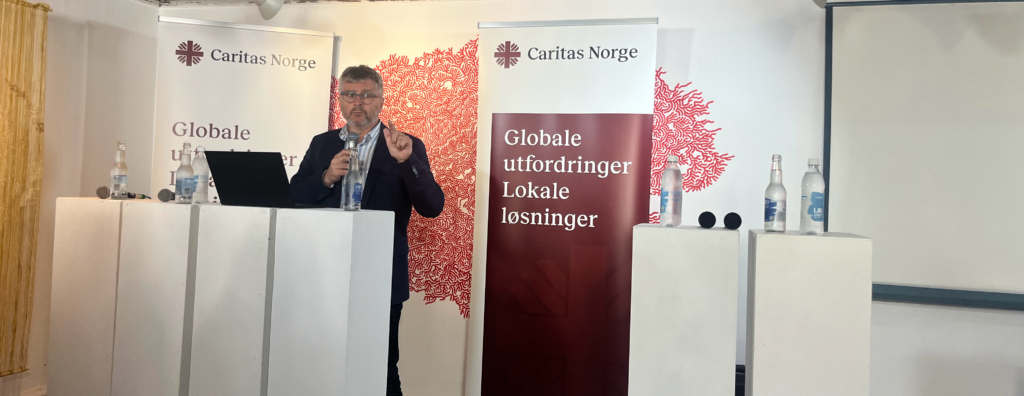
The world has changed.
The aid expert, Øyvind Eggen, helped design Caritas -note. He was very clear that the world has changed and that the way we organize aid work must be adapted to the new reality. First and foremost in the direction of locally led aid, something that has been talked about since the 80s, but which for various reasons has not been able to really achieve. Eggen believed that it is largely about our unwillingness to give up the driving seat and relinquish power and control.
– Behind it lies a thought that "we know best," concluded Eggen.
However, 2025 is the year we must make this happen. The money must be moved from large offices in Oslo and closer to the front line.
– We must realize that those who live there know best, Eggen stated.
Priorities
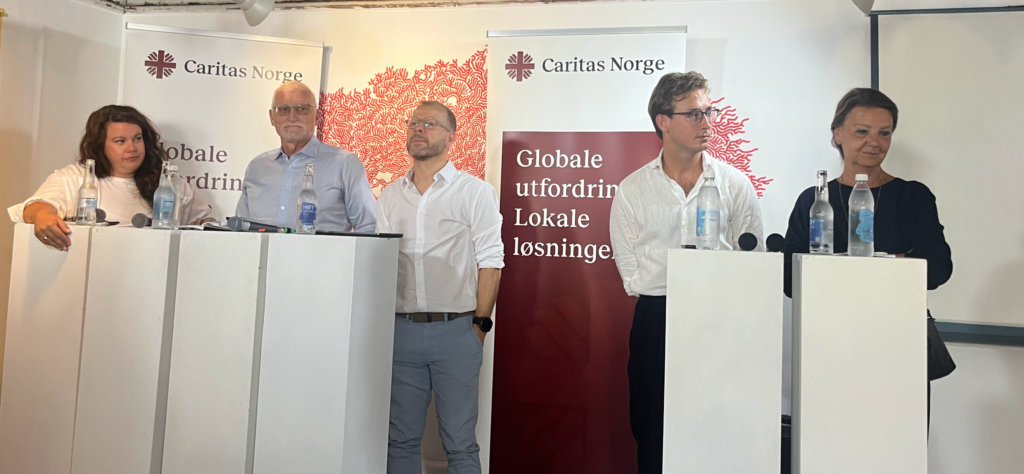
The first question to the panel, consisting of Stine Renate Håheim (Labor Party), Jon Lomøy (former Director of Norad ), Heikki Eidsvoll Holmås (former Minister of International Development), and Hans Jacob Huun Thomsen (Project Manager at Civita), Ingjerd Schou (Parliamentary Representative for the Conservative Party, Foreign Affairs and Defense Committee), was about the need to prioritize.
The primary purpose of Norwegian development assistance is to combat poverty and alleviate suffering in the global south. However, a number of other priorities have emerged, such as pandemic preparedness, reducing greenhouse gas emissions and managing refugees in Norway. Is it time to clean up this and re-prioritize poverty reduction?
Stine Håheim did not agree with the premise that one had to prioritize between poverty alleviation and global common goods, such as climate. After all, it is the poor who are hit hardest by climate change, she pointed out.
– We have no ambitions to change it or make any major reductions in it, said Håheim.
On the contrary, the government will step up climate financing, she stated.
Hans Jacob Huun, from Civita, was not as convinced that it was always right.
“There are some contexts where some of these measures are effective,” he pointed out, “while they are not as effective in other places.” According to Huun, there was probably more to be gained from climate action in middle-income countries than poor ones.
Lomøy was even clearer about that.
– If you want to achieve emission reductions, you have to go to the places where the emissions occur. These are not the poorest countries.
Holmås believed that a primary challenge facing all supporters of aid and development is to ensure that support for Norwegian aid is secured. It is therefore not surprising that other things than poverty reduction are prioritized. One example he cited is peace work. It does not necessarily mean that there will be fewer poor people, but peace work has been a diplomatic door-opener that has, for example, given access to American foreign ministers.
Holmås nevertheless appeared to be quite pessimistic about avoiding Norwegian aid cuts.
– The wave of cuts is also coming to Norway, he stated, pointing out that Sylvi Listhaug argued in exactly the same way as those who have won support for cuts in other countries.
Schou reminded that the Conservative Party has long had its own priorities: education and global health.
She still agreed that it had to be prioritized harder than it is today.
– We will not be able to fill the hole that the US leaves behind
Ukraine vs. Africa
Prioritizing is difficult, but when it comes to which countries will receive support, it seems to be much easier. In 2024, for example, Ukraine (9.3 billion) received more than all of Africa combined (8.4 billion) of Norwegian aid.
How can this be defended when the main purpose of Norwegian aid is to reduce poverty?
– We must be honest that we have a security policy interest in Ukraine, Håheim replied bluntly.
Håheim was again unwilling to accept the premise that one had to prioritize.
– Norway is one of the countries that can afford to do everything, if we continue to allocate money for aid.
Zero Vision for Corruption is pretty idiotic
Schou, from the Conservative Party, was concerned about the need to measure the effect of aid projects, but also believed that local leadership was good.
– You get better results, you activate local forces, and you get more expertise. She also pointed out the need for reforms to make aid more effective.
Locally led aid has obvious advantages, but it will undoubtedly be more difficult to maintain the same degree of control over projects and priorities as today. Huun from Civita believed that this simply has to be tolerated:
– The most important thing is that we must dare to give up control. Become less greedy for control, he stated.
One cannot expect local organizations to fill out Norwegian control forms in the same way as Norwegian aid organizations.
– The zero vision for corruption is quite idiotic. Firstly, because it is unrealistic, but also because it makes us not dare to do something that potentially has great benefits, said Huun.
Holmås pointed out one of the dangers of less control. Aid receives little attention when it is successful, but big headlines if something goes wrong. The less control there is, the more vulnerable you become to criticism of aid.
Of course we should have zero tolerance for corruption, but we cannot turn a blind eye to the fact that corruption is there, said Lomøy.
He believed that the fear of corruption should not stand in the way of the transfer of power and resources to those who do the job, and away from what is in reality an intermediary. This development is taking place anyway, Lomøy believed, regardless of what we in Norway might think.
– Power is taken, not given.
Lomøy also believed that something had to be done about the distribution of risks in the event of corruption and default. Today, the organizations take all the risk. Norad and the Norwegian authorities should also take their share.
Election promise to continue 1% for development aid
In conclusion, Joys asked a direct question to Stine Renate Håheim:
– Yes or no, do you promise at least 1% for development aid in next year's state budget?
– It is an election promise. Yes, the State Secretary replied.
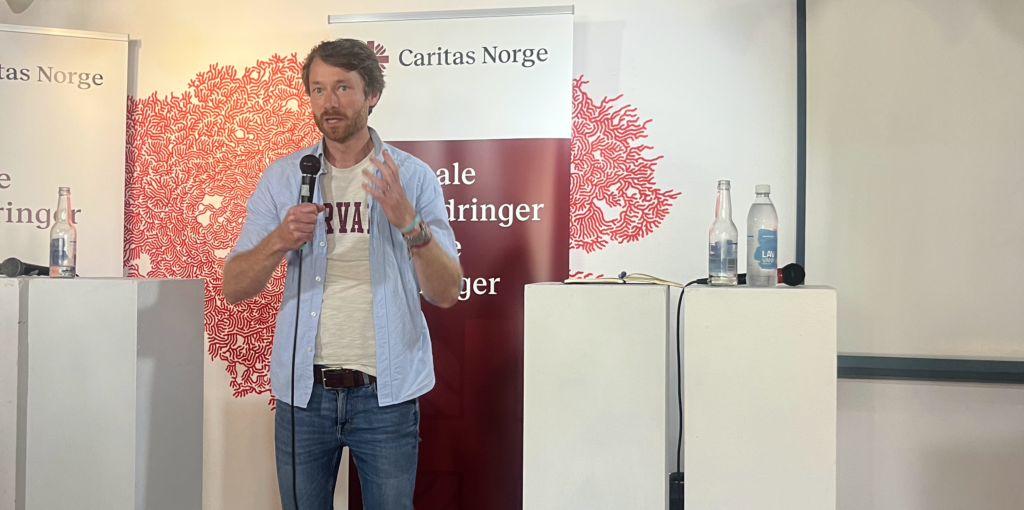
Summary: A turning point for the aid world
Håvard Mokleiv Nygård, Director of Knowledge at Norad, was tasked with summarizing the debate. Before doing so, he asked both the panel and the audience to remember one thing:
– Aid works.
Most people do not believe that, according to opinion polls. So far, there is a great willingness among the Norwegian population to continue providing aid, but faith that aid works is decreasing. Nygård believed that this skepticism is a threat to future aid budgets in the long term.
Nygård pointed out that the debate had been about reporting, among other things. Nygård himself believed that reporting was a secondary issue. The most important thing is to secure the investments, then you can arrange the reporting in secondary order.
The world of aid has changed in several ways, not just because there is less money. For example, the traditional view of rich countries on aid as an important form of so-called soft power has changed. Now, narrower national interests dictate donor willingness, not just in the United States.
It is obviously very bad, but from an aid professional's perspective, all of this is also fascinating, said Nygård.
– We are now in what is an extremely interesting turning point in aid, Nygård stated.
Overview of the participants in the debate:
Stine Renate Håheim (AP) – State Secretary to the Minister of International Development
Jon Lomøy – former director, Norad
Heikki Eidsvoll Holmås – former Minister of International Development
Ingjerd Schou (H) – Member of Parliament, Foreign Affairs and Defense Committee
Øyvind Eggen – researcher and specialist in the effects of aid, editor of Artikulert
Hans Jacob Huun Thomsen – project manager Civita
Håvard Mokleiv Nygård – Director of Knowledge, Norad
Chairman: Ingrid Rosendorf Joys, general secretary of Caritas Norway.